Why a good breakfast can help with alcohol cravings
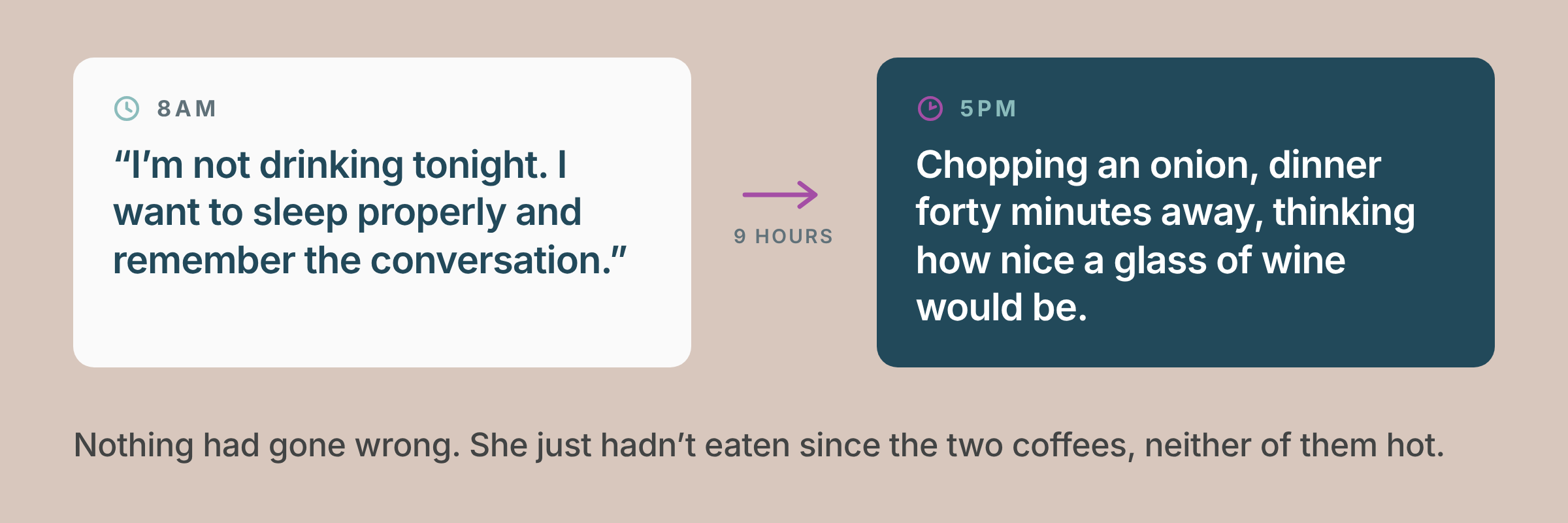
At eight in the morning I could tell you exactly why I didn't want to drink that night. I wanted to sleep properly, seven full hours uninterrupted. I wanted to remember the conversation I'd had with my daughters.
By five, I'd be chopping an onion and thinking how nice a glass of wine would be while I cooked dinner.
So what the hell happened between breakfast and dinner?
Two coffees, neither of them hot
Besides the overwhelm coming at you from every angle, a lot of us skip breakfast. I don't mean the fasting crowd, I mean the majority, and usually it comes down to time.
Ask a woman what everyone in her house ate that morning and there's a fair chance she can tell you. One daughter had eggs, the other took toast in the car, the dog was even fed. And what did she have? Two coffees, neither of them hot.
I'm interested in that woman at five o'clock. She's hungry enough to eat dinner now, but dinner is forty minutes away. The wine, on the other hand, is right there. And if a glass has marked the end of her working day for years, why wouldn't it be the first thing that comes to mind? The time of day, the familiar business of cooking, the setting of the kitchen: all triggers. Then you add hunger on top.
What hunger has to do with drinking
There's a hormone called ghrelin, made mainly in the stomach, that helps tell your brain you're hungry. It rises when you haven't eaten for a while. What caught my attention is that alcohol researchers study it too, because ghrelin also affects how much people want to drink.
Dr Lorenzo Leggio, who researches addiction at the US National Institutes of Health, has spent years looking at how the body and the brain work together in addiction. His team found a rather clever way to test what that means.
In one experiment, researchers gave people with alcohol dependence an infusion of ghrelin or a placebo, then exposed them to alcohol cues. Those who received the higher dose of ghrelin reported a stronger urge to drink. In another, participants could press a button to give themselves small, controlled doses of alcohol. On the days they received ghrelin, they pressed for more.
A hormone we usually associate with wanting lunch had influenced how much alcohol people chose to have.
Where protein comes in
So if higher ghrelin means a stronger urge, the next question is what keeps it lower. That's where all the talk about protein and cravings comes from. Protein is the most filling thing on your plate and it tends to keep ghrelin down for longer than a carb heavy snack.
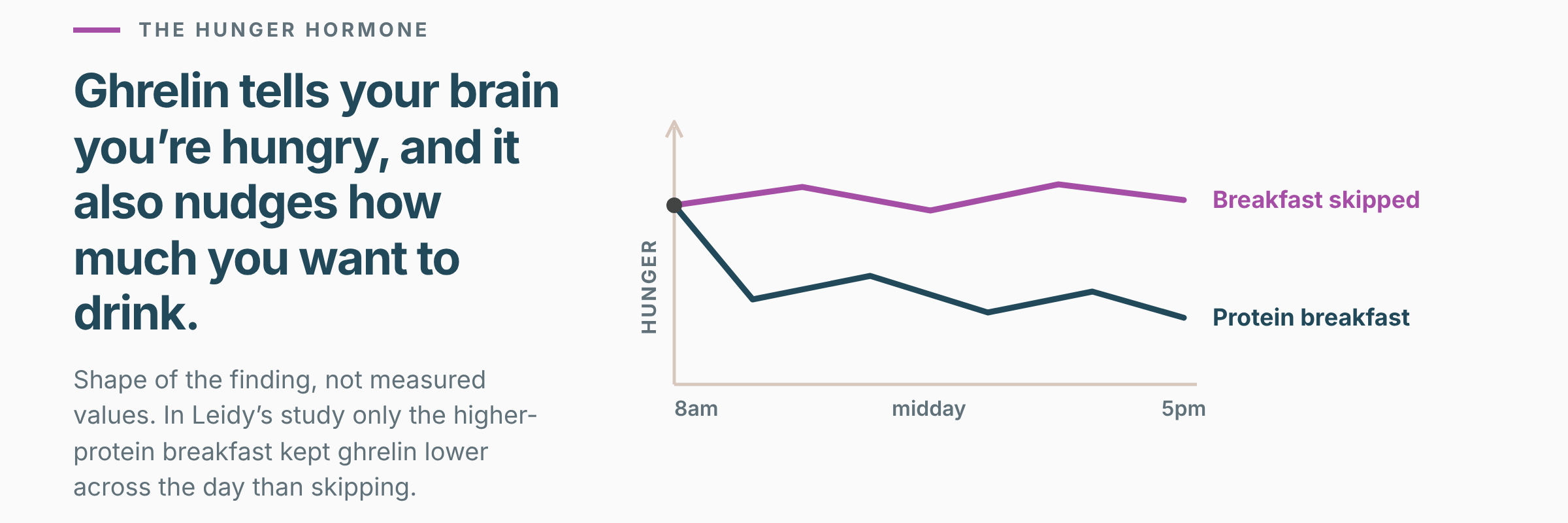
In a separate breakfast study, nutrition researcher Heather Leidy and her colleagues compared two breakfasts containing the same amount of energy, in a small group of young women who usually skipped the meal. Both breakfasts eased hunger. The women felt fuller after the one with more protein, and it was the only breakfast that kept their ghrelin lower across the day compared with skipping.
Put the two lots of research side by side and you can see why eggs on toast keep coming up. Skip breakfast and ghrelin stays high. Higher ghrelin, in the lab at least, means a stronger pull towards a drink. A protein breakfast helps bring it down.
What the research can and can't tell us
The research gives us good reason to pay attention to hunger when we're changing our drinking. It can't tell us that a particular breakfast will prevent tonight's craving, because none of these studies were set up to test that.
My reason for eating breakfast is more practical. If five o'clock is already the hardest part of my day, arriving there ravenous gives me one more uncomfortable feeling I'd quite like to get rid of.
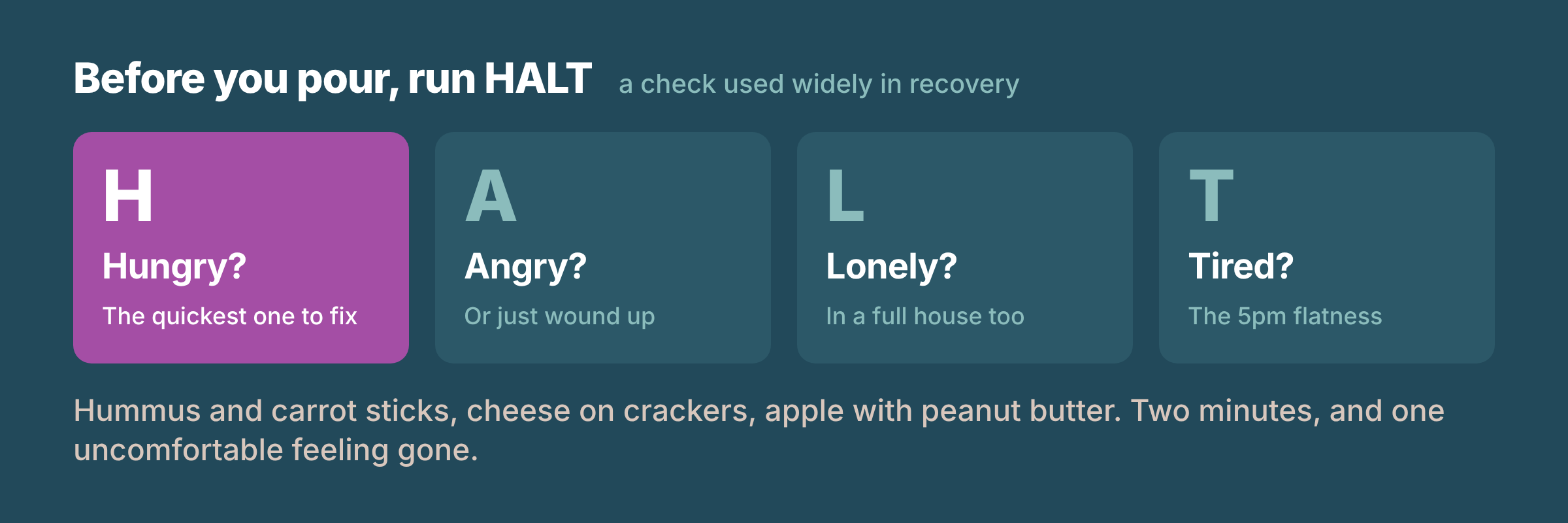
Hungry, angry, lonely, tired
In recovery, many allied health professionals introduce a tactic called HALT. Am I hungry, angry, lonely or tired? Hungry is the one I can usually do something about quickly. Hummus and carrot sticks, cheese on crackers, apple slices with peanut butter. It literally takes a couple of minutes in the afternoon, and a day of good protein has been shown to have an even larger effect on curbing our urges.
A good breakfast is not going to make all the urges disappear. What it will do is make sure it isn't adding to them. For many people it helps, and helps considerably.
But you might still want a drink. Or you might just need to decompress for a moment between finishing work and somebody asking what's for dinner. For years, pouring a glass gave me permission to take those ten minutes. If the urge is still there once I've eaten, that tells me something worth knowing about the job I've been asking alcohol to do.
At the beginning it's a journey of curiosity and awareness. You don't have to fix it all at once, but you have no chance if you don't understand what's driving the habit.
Start with a decent breakky
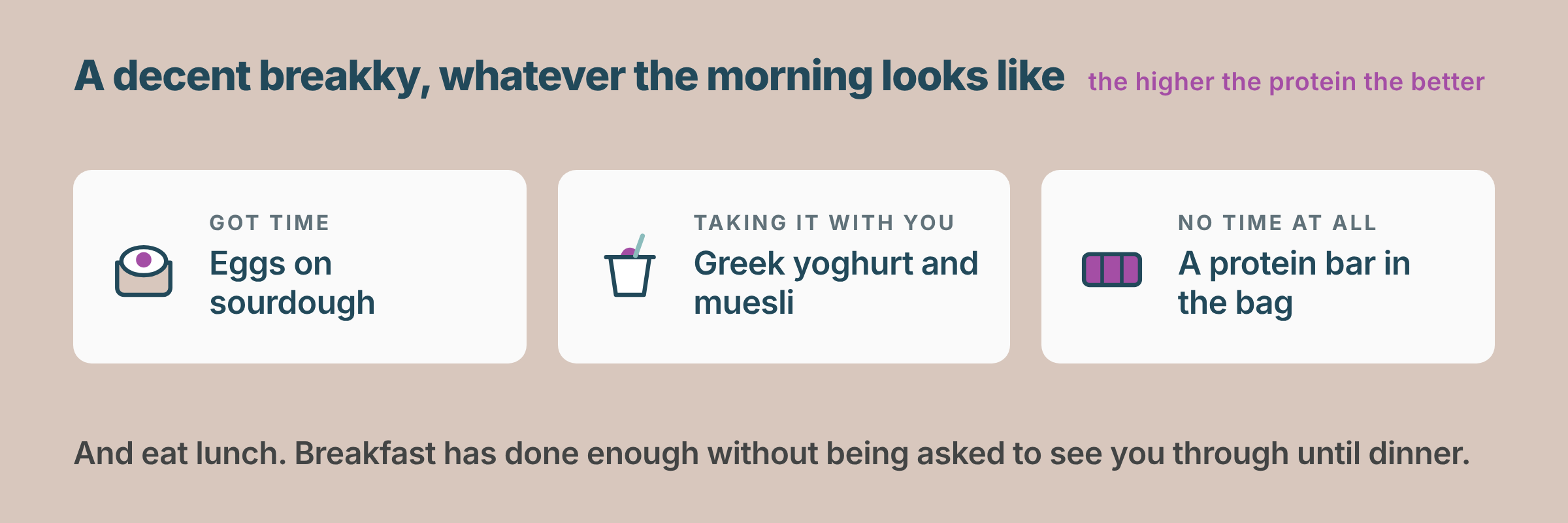
So this week, why don't you try, if you don't already, starting with a decent breakky. Eggs on sourdough if you've got time. Greek yoghurt with mango and muesli if you're taking it to work. A protein bar in your handbag or an Up and Go if time is of the essence. The higher the protein the better.
And eat lunch. Breakfast has done enough without being asked to see you through until dinner.
Two different evenings
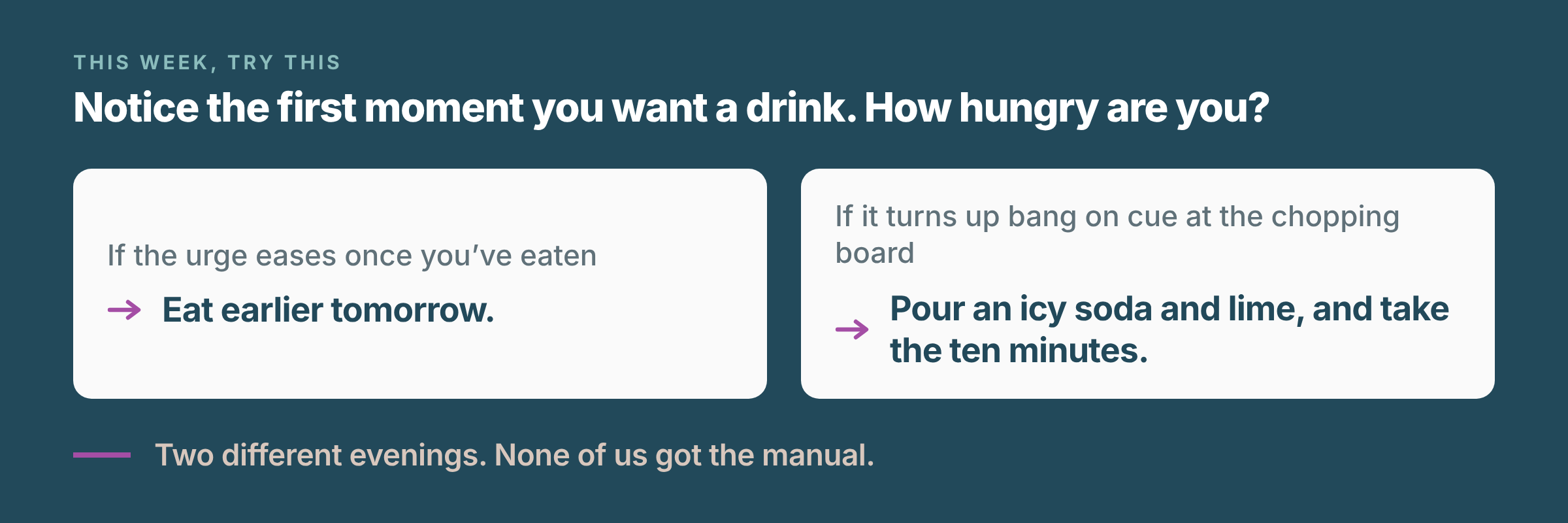
For a few days, notice the first moment you want a drink. How hungry are you? What are you doing? Does the urge ease once you've eaten, or does it arrive bang on cue when you pull out the chopping board, regardless of what you had for lunch?
Those are two different evenings. On one, it might help to eat earlier. On the other, I'd pour an icy soda and lime, sit down for the ten minutes I wanted, and let dinner be ten minutes later.
Either way, change the routine or the environment slightly, and take a pause between work and the home work.
None of us got the manual.